
Standing Water on the Lawn
Water pools for hours or days after rain instead of soaking away naturally.
When rain won't drain away from your property, it isn't always obvious who to call for stormwater drainage in Hamilton. Is it a plumber, the council, or a specialist drainage contractor? The answer depends entirely on where the water problem actually starts, and getting it wrong usually means a wasted call-out and another day waiting for the right trade.
This guide explains how to recognise a genuine stormwater issue, who is responsible for fixing it, and why Hamilton Drainage and Plumbing is set up specifically for this kind of civil drainage work rather than treating it as an add-on to general plumbing.
Stormwater problems rarely announce themselves clearly. They usually show up as pooling water on the lawn, a driveway that stays wet long after rain has stopped, or water backing up around a soak hole during heavy downpours. Because these signs build up gradually, many property owners live with a partly-failing system for years before calling anyone.
In more serious cases, stormwater can push against foundations, seep into crawl spaces, or overwhelm an undersized pipe network entirely, leading to flooding across paths, garages, or low-lying parts of a section. Once water starts finding its way indoors, the cost of the fix tends to climb quickly.
Most stormwater failures come down to a handful of causes: pipes that were undersized for the property when it was first developed, soak holes that have gradually clogged with silt, or extra hard surfaces such as new driveways and patios that send far more runoff into the same original system.
Tree roots are another common culprit, working their way into pipe joints over years until a small crack becomes a full blockage. None of these issues tend to announce themselves suddenly. They build slowly until a heavy rain event finally exposes how little capacity is left.
Common Signs It's Time to Call a Stormwater Specialist
Water pools for hours or days after rain instead of soaking away naturally.
Surface water collects instead of running to a drain or soak hole as designed.
Guttering discharges faster than the connected stormwater line can carry it away.
Moisture builds up under the house, often linked to a failing soak hole or blocked pipe.
Soil washes away from the same spot every time it rains heavily, undermining paths or garden beds.
An infiltration pit that used to clear quickly now takes far longer, or doesn't clear at all.
Council-owned stormwater mains sit outside your boundary and are the council's responsibility to maintain. Everything from the house to that connection point, including gutters, downpipes, and private soak holes and drains, is typically the property owner's responsibility, even where the problem seems to originate from further down the line.
That's where a specialist drainage contractor comes in. Rather than guessing whether the problem sits on your side of the boundary, a proper site inspection can trace the water path, check pipe condition, and confirm exactly where the fault lies before any council involvement is needed.
Delaying stormwater repairs rarely makes the problem smaller. A slow-draining soak hole tends to clog further with each heavy rain event, and a section that floods occasionally can start flooding every time as pipe capacity keeps shrinking.
The longer-term costs can be significant too. Persistent moisture around foundations can affect structural timber, driveways can crack and settle unevenly, and insurers increasingly ask about known drainage issues when assessing flood-related claims.
A stormwater specialist assesses fall, pipe condition, and soakage capacity, then designs a fix that matches your soil and site layout. That might mean installing new soak holes, replacing an undersized pipe, or redirecting surface water away from vulnerable areas such as bathrooms or living spaces built close to ground level.
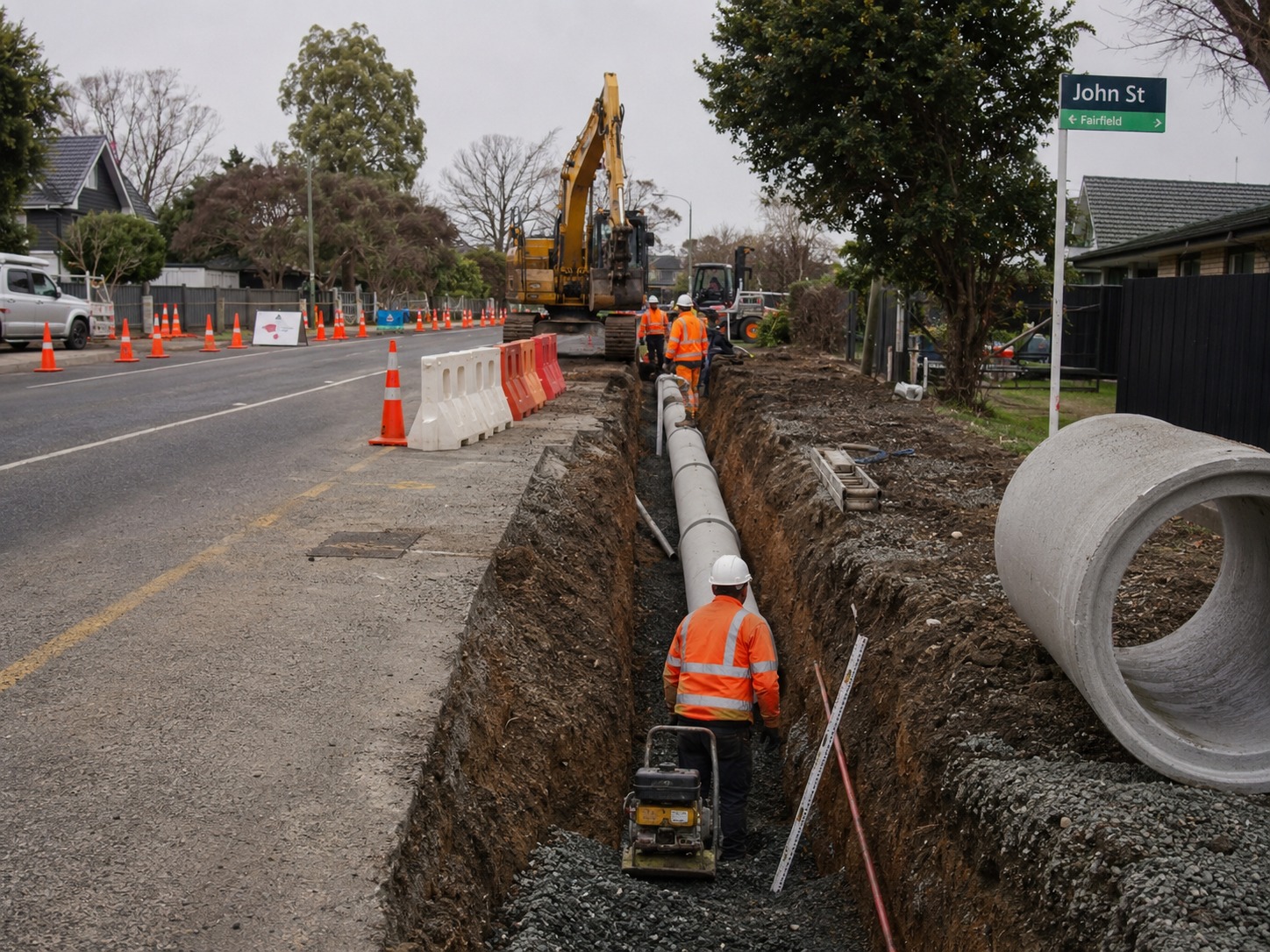
For larger properties or commercial sites, this can also involve coordinating excavation work to reach and replace deeper sections of the network without disturbing the rest of the property, or staging the work so a business can keep operating while it's carried out.
Regular maintenance goes a long way toward preventing serious stormwater failures. Clearing debris from gutters, checking that downpipes discharge freely, and having soak holes inspected every few years can catch a slow decline long before it turns into a flooded section during the next heavy downpour.
For older properties, it's also worth having the underground network assessed even if nothing looks obviously wrong yet. Pipes installed decades ago were often sized for a much smaller roof and driveway area than what now sits on the same section, and catching an undersized system early is far cheaper than repairing storm damage after the fact.
We work across Hamilton and the surrounding Waikato district, so whether you're dealing with a single flooded lawn or a wider stormwater network serving several properties, the same careful assessment process applies before any work is quoted or carried out.
If water is pooling somewhere it shouldn't, contact our team for a free on-site assessment. We'll tell you plainly whether it's a stormwater issue, a plumbing issue, or a matter for the council, and quote accordingly.