Site Assessment and Design
Reviewing existing levels, soil, and runoff before finalising a drainage plan.
Commercial properties place very different demands on a drainage system than a residential home. Higher water volumes, larger paved areas, and stricter council compliance all mean commercial drainage installation across Hamilton and the wider Waikato region needs a contractor comfortable working at scale, not just a residential-focused team taking on a bigger job.
Whether you're developing a retail site, an industrial yard, or a multi-unit development, getting the underground drainage design right from the start avoids expensive rework later, particularly once concrete, paving, or landscaping has already gone in over the top.
Commercial drainage work in and around Hamilton spans a wide range of property types: retail developments, industrial yards, hospitality venues, warehouses, and multi-unit residential complexes. Each brings its own runoff patterns, and a good design accounts for how the site will actually be used, not just its footprint on paper.
Fit-outs and tenancy changes can also trigger drainage work, particularly where a new commercial kitchen, car wash, or trade waste requirement needs a dedicated connection that the existing system was never designed to handle.
Commercial projects typically combine stormwater management, sewer connections, and surface drainage across car parks, driveways, and loading areas. Our drainlaying team plans pipe routes, falls, and soakage capacity around the finished layout, not just the current site conditions, so the system performs correctly once the site is fully built out.
Concrete driveway and yard drainage is a common requirement for commercial sites, since large paved areas generate far more surface runoff than a typical residential section. Getting the channel drain placement and pipe sizing right the first time prevents pooling across customer or loading areas, which can quickly become a liability issue for a business.
Commercial drainage work usually needs to satisfy council stormwater and sewer connection standards before a project can proceed, particularly where a new building consent or resource consent is involved. Getting this sequencing wrong can hold up an entire project timeline.
A contractor experienced in commercial work will know what documentation councils expect, and can plan drainage installation to align with building inspections rather than working around them after the fact.
Commercial Drainage Services We Provide
Reviewing existing levels, soil, and runoff before finalising a drainage plan.
Sizing and laying pipe networks to handle commercial-scale surface water.
Connecting new builds or extensions to council infrastructure correctly.
Channel drains and surface solutions for car parks and loading areas.
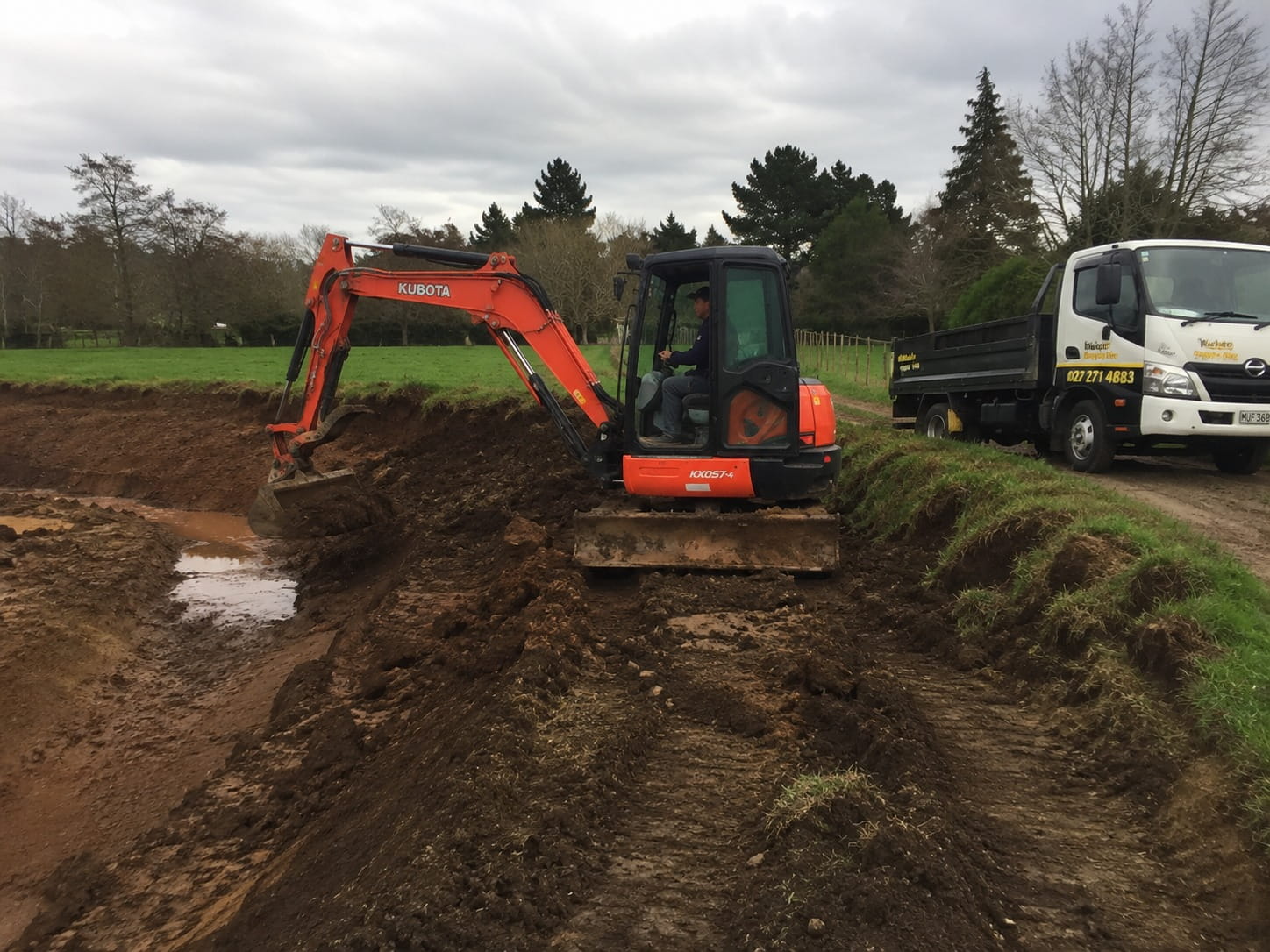
Machinery-led groundwork suited to larger commercial footprints.
Restoring surfaces to a commercial-grade finish once pipework is complete.
General contractors and residential plumbers aren't always set up for the scale of a commercial site. Larger pipe diameters, multiple connection points, and staged construction schedules all require a contractor used to coordinating with builders, engineers, and council inspectors across a longer project timeline.
A specialist team can also plan around excavation and machinery access more efficiently, reducing disruption to an active worksite or operating business, which matters when downtime has a direct cost.
Commercial drainage work often needs to happen while a business is still trading, which changes how a project gets planned. Staging excavation around trading hours, keeping access clear for customers or deliveries, and fencing off work areas properly all matter as much as the drainage design itself.
Experienced commercial contractors will scope this into the quote from the outset, rather than discovering partway through that the car park needs to stay open on weekends or that a loading dock can't be blocked during business hours.
Ask any prospective contractor about their experience with commercial-scale projects specifically, not just residential drainage taken on at a larger size. Insurance requirements, machinery capacity, and crew size all need to match the scale of a commercial site, and a contractor without recent commercial references may not have the systems in place to manage a larger job smoothly.
It's also worth asking how they coordinate with other trades on site. Commercial projects usually involve builders, electricians, and civil engineers working around the same schedule, and a drainage contractor comfortable fitting into that environment will save you time managing the project yourself.
Finally, ask about reinstatement standards. Commercial sites are judged on their finished appearance as much as their function, so channel drains, concrete patching, and surface reinstatement need to be completed to a standard that looks intentional, not repaired.
We work with commercial clients throughout the wider Waikato region, including Cambridge and Te Awamutu, as well as Hamilton city. Regional experience means we understand the soil conditions and council requirements that vary from site to site, rather than applying a one-size-fits-all approach.
For larger developments, commercial drainage installation is often just one part of a wider civil scope. See our guide on drainage for subdivision development for how we support developers from early earthworks through to final handover.
Every commercial site is different, from a single retail tenancy to a multi-building industrial park, and the drainage scope should reflect that rather than following a generic residential template scaled up in size.
Planning a commercial build or upgrade? Request a free estimate and we'll scope the drainage requirements before your project breaks ground.