Site Access
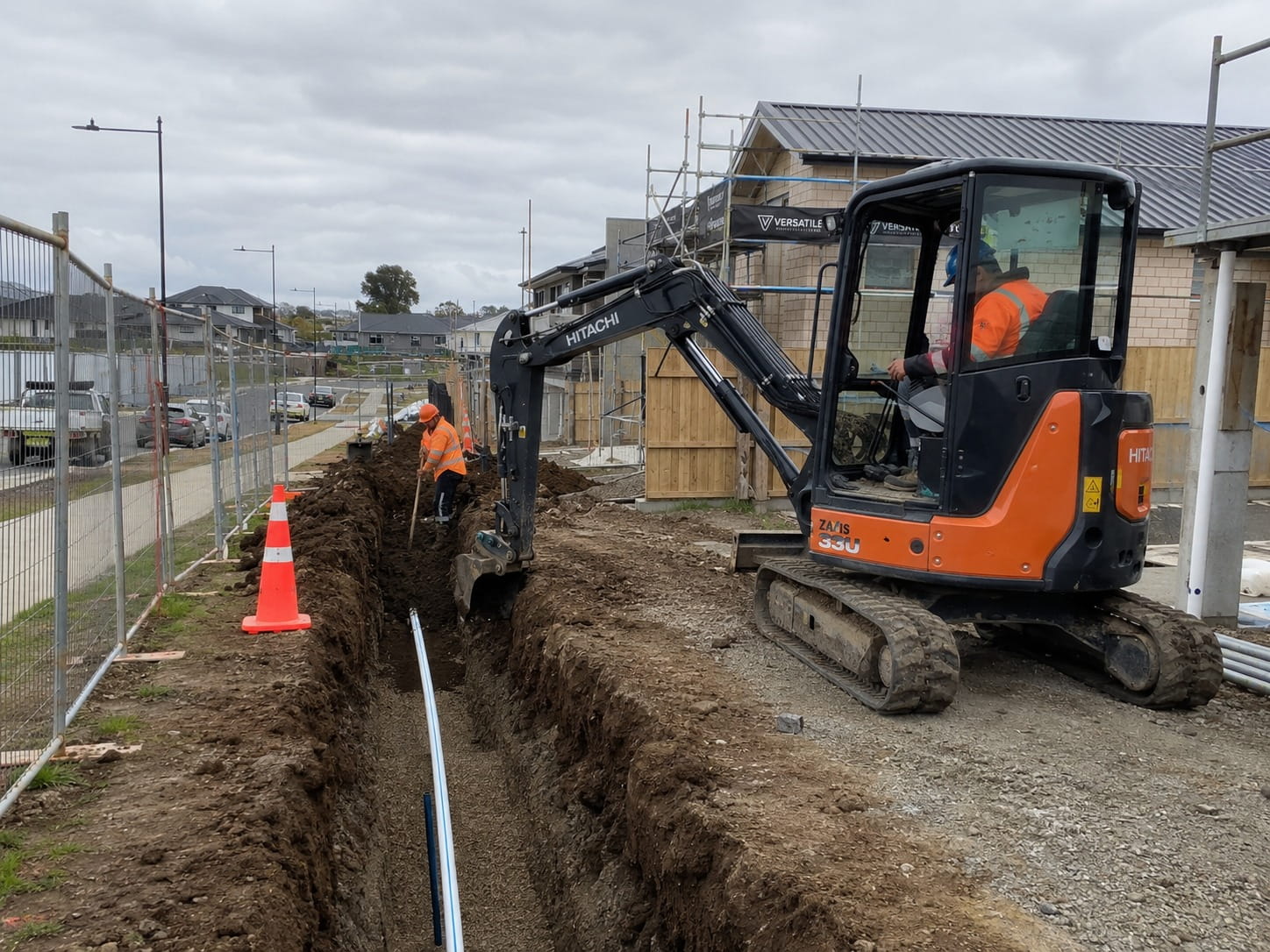
New builds offer open access; renovations often work around existing structures and landscaping.
Whether you're building a new home or renovating an existing property, drainage is one of those trades that changes significantly depending on the type of project. A drainage contractor for a new build works from a blank canvas, while renovation work often means adapting to decades-old pipework hidden underground.
Understanding these differences helps set realistic expectations for cost, timeline, and what a contractor actually needs to assess before quoting your project.
On a new build, we typically get involved once site plans are close to final, reviewing levels, connection points, and any easements before excavation starts. Our goal is to confirm the drainage design works with the finished layout, not just the current cleared section.
On a renovation, we usually start with a closer inspection of what's already underground, sometimes using a camera to check pipe condition before recommending whether a repair, partial replacement, or full upgrade makes the most sense for the budget and timeline involved.
New build drainage starts with a clean site plan. Pipe routes, falls, and connection points can be designed around the finished layout from the outset, coordinated directly with excavation and the wider build programme managed by your builder.
This doesn't mean new builds are simple, though. Drainage still needs to account for the final landscaping, driveway placement, and any future additions, since retrofitting drainage after a new build is complete is just as disruptive as on an older property.
Renovation drainage work usually means working around what's already there. Older pipework may be undersized, deteriorated, or positioned in ways that no longer suit a renovated layout, particularly where a bathroom renovation or extension changes the fixtures sitting above it.
Access is often more limited on renovation projects too, with established landscaping, driveways, or structures restricting where machinery can reach. This tends to make renovation drainage work slower and more methodical than an open new-build site.
Key Differences Between New Build and Renovation Drainage
New builds offer open access; renovations often work around existing structures and landscaping.
New build drainage is designed from scratch; renovation work adapts to existing pipe routes.
Renovations may uncover ageing or damaged pipes not visible until work begins.
New builds align with the wider construction programme; renovations coordinate around occupied living spaces.
Renovation drainage work often affects an occupied home; new build work does not.
New build costs are generally easier to estimate upfront than renovation work with unknown underground conditions.
Some property owners assume new build and renovation drainage need entirely different specialists, but the underlying skills are the same: reading fall correctly, choosing suitable materials, and installing pipework that will perform reliably for decades. What changes is the working environment, not the trade itself.
A contractor comfortable moving between both project types brings a useful perspective to each. New build experience reinforces good design habits, while renovation experience sharpens the problem-solving needed when a site doesn't go exactly to plan.
New build drainage typically happens early in the construction programme, before slabs are poured or foundations are finalised, which means delays at this stage can hold up every trade that follows. Getting drainage confirmed quickly keeps the wider build on schedule.
Renovation drainage timing is usually more flexible on paper, but in practice it's constrained by the household living around the work. Staging excavation to minimise disruption, keeping access clear, and protecting finished areas nearby all take more planning than on an empty section.
If you're planning a new build, involve your drainage contractor early alongside your builder and civil engineer, so pipe routes are settled before foundations go in. If you're renovating, expect your contractor to want a closer look at existing pipework before confirming a final price, much like the process we outline in our guide to drainage installation costs in Hamilton.
Either way, the same standard of workmanship applies. New build or renovation, drainage needs to be installed correctly the first time, since it's one of the few trades that becomes very expensive to fix once it's buried under a finished surface or a freshly poured driveway.
We work on both ends of this spectrum regularly, from ground-up subdivision developments through to single-room renovation work, which means we're comfortable adjusting our approach to whichever stage your project is actually at.
Planning a new build or renovation project? Contact our team to discuss your drainage scope, whatever stage your project is at.